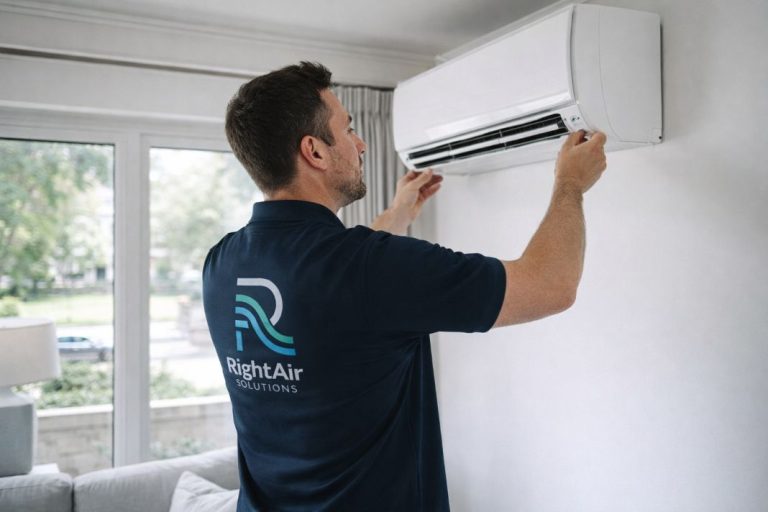
RightAir Solutions is a company that specialises in commercial air conditioning services.

Why do air conditioning installations require site surveys?

Before any air conditioning system is designed, the engineer needs to understand the property itself. A site survey allows them to examine how heat behaves in the space, how air moves, and what physical or electrical limitations might affect installation. Without this step, even the best equipment can perform poorly or require rework.

The visit usually takes 30 to 60 minutes. Homeowners don’t need to prepare in advance, but having full access to the property helps the engineer assess all areas that may influence design decisions.

Why Air Conditioning Installations Always Start With a Site Survey?

This is the stage where the building starts to shape the system. An engineer walks through each space with intent, observing how rooms are used, noting ceiling heights, checking for airflow pathways, and identifying potential equipment locations. They’re not just collecting data; they’re interpreting how the property will respond to cooling.

The process draws on regulations such as Part F and Part L, along with manufacturer installation standards. These influence what’s possible, what’s required, and what risks need to be addressed early.

What Engineers Look For During a Site Survey? (And Why Photos Don’t Tell the Whole Story?)

Photos offer reference points, but they don’t show context. An in-person assessment reveals where voids exist, whether walls can carry weight, how sound travels, and whether electrical circuits can support the added load. Engineers test noise levels in real time, check wall densities, and inspect roof spaces to assess pipework access.

These checks can prevent costly errors later. If the homeowner prioritises low noise or visual discretion, the engineer adjusts their focus, avoiding visible trunking or reducing compressor noise through strategic placement and mounting.

Manufacturer noise maps and local authority guidance also help determine the appropriate placement of external units, especially in dense residential areas. This forms part of the broader acoustic planning for air conditioning.

During a good site survey, the engineer should check:

  1. Wall and ceiling voids for pipe and duct routing.

  2. Sound paths and material density for noise control.

  3. Breaker capacity and load availability.

  4. Drainage options and slope for condensate.

  5. Access routes for units and equipment.

  6. Room usage patterns and heat zones.

  7. Opportunities to hide or recess trunking.

Pro Tip: Always ask if your installer performs a full on-site survey before quoting. It’s a key sign of professionalism.

How Your Property’s Layout Shapes the Air Conditioning System You Need?

The layout determines what’s feasible and what may present challenges. High ceilings might require larger units or different diffuser types. Open-plan spaces often benefit from multiple zones to maintain even temperatures. Staircases, corridors, and awkward transitions can complicate refrigerant runs.

The survey helps identify these constraints early. It allows the system to respond to the shape and use of the home rather than relying solely on size or floor area.

Understanding Heat Load and Airflow: The Science Behind Choosing the Right AC Unit

Cooling capacity must match the building’s actual heat gain. Engineers calculate this using insulation levels, solar exposure, window area, room volume, and the number of occupants.

An oversized unit tends to short cycle, switching on and off too often, which increases wear and causes uneven cooling. Undersized units run constantly and still struggle to achieve comfort.

SEER (Seasonal Energy Efficiency Ratio) and SCOP (Seasonal Coefficient of Performance) ratings are also considered when selecting energy-efficient AC systems that deliver consistent performance while consuming less power.

Airflow design is equally important. Poor diffuser placement can lead to hot spots, draughts, or noise issues. The survey enables engineers to plan duct routes and grille locations with these variables in mind.

Designing AC Systems That Blend In: Why Surveys Matter for Aesthetics

A good system should function quietly in the background and look like it belongs in the space. During the survey, the engineer checks whether grilles can align with lighting, if ducts can run through ceiling voids, and whether trunking can be avoided entirely. In homes with distinctive interiors or period features, this is often where the system either integrates well or stands out unnecessarily.

These discussions may also involve designers or architects, especially in high-end projects. The survey is the moment where aesthetic goals and practical routes start to align.

Book Your AC Site Survey Today

Ready to install air conditioning? Let us assess your space properly first.

Planning for Quiet Operation: Noise Considerations Identified During Surveys

Most people don’t want to hear their air conditioning. The engineer listens for where sound might travel through walls or floors, checks which materials could amplify vibration, and plans bracket placement to reduce these risks. Outdoor unit location is chosen to minimise disturbance to neighbours and to meet local noise regulations.

Ductwork is routed to reduce turbulence, and diffusers are placed to keep airflow smooth and quiet. These steps help create a quiet AC installation that supports comfort from day to night.

Identifying Structural, Electrical and Drainage Constraints Before Work Begins

Many installation risks are hidden in the building’s structure. Wall type determines whether core drilling is safe. Joist direction influences whether a pipe can run from one space to another. The engineer also checks whether the consumer unit can support additional load and whether new isolators or circuits are necessary.

Drainage planning is essential. Condensate often relies on gravity fall; if that’s not possible, a pump will be needed. These details may not appear in plans or drawings, but a trained engineer will see them during the visit.

The survey also considers access and serviceability, helping to ensure the system remains maintainable and reliable in the long term.

How Site Surveys Prevent Installation Surprises, Delays and Hidden Costs?

Most project delays occur when important issues aren’t identified early enough. The survey prevents this. It highlights problems in advance, whether it’s a wall that needs a longer pipe route, a location that needs scaffolding, or a unit that won’t fit through a tight access point.

This allows the installer to quote accurately and bring the right materials and tools on the first day. It reduces last-minute changes, unexpected costs, and stressful rerouting. It also provides the homeowner with a clear and realistic view of the entire project.

This kind of planning is key to air conditioning performance that avoids rework, disruption, or poor outcomes.

Pro Tip: Prioritise systems designed around heat load and layout, not just room size. Comfort depends on the details.

Why Different Installers Give Different Quotes: It Starts With the Survey?

Quotes vary in quality because surveys vary in depth. Some are based on quick assumptions, a few photos, rough dimensions, or a floorplan. Others result from a detailed in-person assessment. The difference becomes clear once installation begins.

A quote based on a thorough survey accounts for access, sound control, cable runs, drainage, and aesthetics. It might not be the cheapest, but it is more likely to be complete. Understanding why AC quote differences exist helps clients choose based on substance, not surface.

Why Older, Extended or Unusual Properties Depend on Detailed Surveys?

Older and adapted buildings contain more variables. Joists may not follow standard spacing. Wall materials may be fragile or unusually thick. Voids may be inaccessible. Extensions often have different construction quality compared to the original structure.

These don’t make installation impossible, they just mean planning must be specific and cautious. The survey brings these challenges into focus before work begins.

Need a Quiet and Discreet AC System?

Our engineers design low-noise systems that blend into your home seamlessly.

How Survey Findings Turn Into a Precise Installation Plan?

Everything observed during the survey feeds into the installation plan. Measurements guide where units will be placed. Cable lengths are calculated. Bracket types are selected. Drainage slopes are mapped. Engineers compile annotated diagrams or step-by-step checklists to guide the fitting team.

This approach avoids confusion on-site and ensures the completed system matches the intent. There’s less improvisation and more alignment between plan and execution.

The Survey as the Blueprint for Comfort, Efficiency and Long-Term Performance

Every balanced temperature and quiet hum begins with what the engineer learns during the site visit. The survey determines where air will flow, how it will be distributed, how quietly it will operate, and how neatly the system will fit the home.

RightAir Solutions often uses this phase to quietly assess long-term performance, thinking beyond installation day to how the system will function through years of use.

That’s why companies like RightAir Solutions place as much focus on the survey as they do on the install. The survey is how comfort, energy performance, and system harmony are built in from the start, not left to chance.

Compare AC Quotes with Confidence

Not all quotes are created equal. We show you exactly what matters during installation.

Share

Read Similar Blogs

RightAir Solutions

32 Donnington Rd, London NW10 3QU
 
020 3886 2326
 
GQRC+JX London