
RightAir Solutions is a company that specialises in commercial air conditioning services.

What confirms that an air conditioning installer in London is properly certified?

A properly certified air conditioning installer in London will hold valid F-Gas certification, be registered with recognised industry bodies, carry appropriate insurance, and demonstrate recent experience on projects similar to your own. Verifying these credentials ensures legal compliance, installation safety, system performance, and long-term reliability.

Table of Contents

Why Certification Matters in London Installations

In London, certification is not simply a formal requirement. It serves as a protective layer for both property owners and occupants. The challenge of older buildings, high-value interiors, and access constraints across many parts of the city means that unqualified installers introduce significant risks. These can extend beyond poor workmanship to legal liability and insurance voidance.

Improper or uncertified installation can result in:

  • Leaks due to incorrect refrigerant handling
  • Non-compliance with Building Regulations, affecting saleability
  • Voided manufacturer warranties
  • Increased energy inefficiency and system noise
  • Insurance disputes following property damage

London’s varied property stock adds further challenge. From listed homes in Hampstead to modern flats in Notting Hill, each building presents its own constraints. Certification becomes a baseline that assures the installer understands those constraints and works within regulatory boundaries.

Pro Tip: Always check that F-Gas certification applies to the individual attending the site, not just the company.

Look for F-Gas Certification: The Legal Minimum

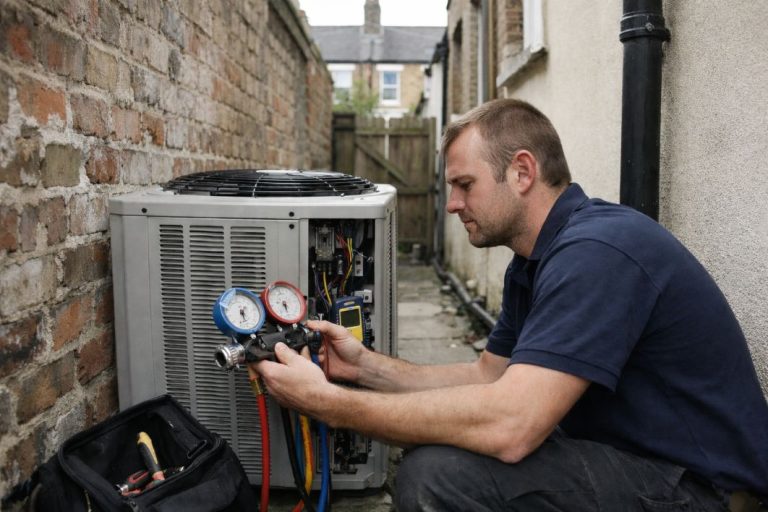
Anyone installing or servicing systems that contain fluorinated gases must, by law, hold an F-Gas qualification recognised by the UK government. This includes most split, ducted, and VRF systems found in both residential and commercial properties across London.

To verify:

  1. Ask for the installer’s F-Gas certificate. It should reference City & Guilds 2079 or an equivalent qualification.
  2. Check their registration on the REFCOM register or equivalent government-approved database.
  3. Confirm whether the qualification applies to the individual or company. Both need relevant coverage if multiple staff are involved.
  4. Avoid assumptions. A business claiming company certification may still send unqualified personnel.

Beyond legality, F-Gas certification ensures the installer understands refrigerant handling, leak detection protocols, and environmental responsibilities. In practice, this means reduced leak risk, better system charging, and a lower chance of catastrophic system faults.

Book a Certified AC Installer Site Assessment

Schedule a professional survey with a fully accredited specialist who understands London property challenges.

Confirm Registration with a Recognised Certification Body

While F-Gas compliance is required, additional qualifications from recognised industry bodies signal a broader commitment to quality and accountability. These registrations are not mandatory, but they help differentiate professional contractors from general technicians.

Key bodies to know:

  • NICEIC: Confirms electrical safety standards. Important for installers integrating air conditioning into existing electrical infrastructure.
  • REFCOM Elite: Extends beyond F-Gas to cover best practice in system design, environmental controls, and procedural audits.
  • BESA: Indicates adherence to industry standards and ongoing technical development for building services engineers.
  • TrustMark: Government-endorsed accreditation reflecting commitment to consumer protection and fair trading.

Always verify an installer’s active status on these organisations’ websites, noting that membership alone does not imply competence unless backed by assessment or auditing.

Ask About Manufacturer Training and Authorisation

Many leading air conditioning manufacturers offer formal training programmes and authorisation schemes for installers. These programmes ensure that systems are installed according to brand-specific protocols, which directly affects reliability.

For example, a Mitsubishi Electric partner will be trained in controls integration and noise management unique to that system, while Daikin-authorised installers follow structured commissioning procedures that protect warranty eligibility.

Two installers might claim to be familiar with a brand. However, only one may be authorised. The difference often plays out in longer system lifespan, higher efficiency, and fewer early faults.

To clarify:

  • Ask which brands the installer receives ongoing training from.
  • Request confirmation of authorised status, not just familiarity.
  • If the property has specific acoustic or aesthetic constraints, trained installers are more likely to handle these subtly and correctly.

This additional insight can be especially important in high-spec residential renovations or mixed-use London properties, where integration needs to be smooth both visually and functionally.

Pro Tip: For period properties, ask for examples of installations completed without disturbing listed features or interior finishes.

Verify Public Liability and Professional Indemnity Insurance

Certification confirms competence, but insurance offers financial protection if something does go wrong. Without it, legal disputes or property damage can leave the property owner exposed.

Two key types of insurance apply:

  1. Public Liability Insurance: Covers accidental damage to property or injury caused during works.
  2. Professional Indemnity Insurance: Protects against flaws in system design or specification that result in later problems.

You can ask:

  • What level of Public Liability and Professional Indemnity insurance do you carry?
  • Can you provide a certificate of insurance or contact details for confirmation?

In many London homes and commercial premises, the installation occurs around finished interiors, tight access corridors, or sensitive equipment. The ability to absorb or cover any resulting issue is part of responsible project delivery, not an afterthought.

Check for Recent and Relevant Project Experience

Certification proves potential, but experience proves capability. In London especially, air conditioning projects frequently present physical and regulatory constraints that generic experience may not cover.

When reviewing an installer’s portfolio, ask:

  • Have you completed projects in similarly sized or aged properties?
  • Do you have experience in homes with listed features or shared access rules?
  • Can you show examples of installations where the system is visually unobtrusive?
  • Have you managed tight acoustical requirements in residential settings?

Even a smaller firm may have deep, specific knowledge of West and North West London properties. The key is alignment between their experience and your conditions. Quality outcomes often stem from understanding how to work respectfully within the property’s layout, not the size of the installer’s portfolio.

Request Installer Credential Review

Let us verify certifications, insurance, and experience for your shortlisted air conditioning professionals.

Observe How the Installer Approaches the Site Assessment

The pre-installation planning phase is when professionalism becomes clearest. A certified installer will treat the initial site survey as more than a formality. They will ask targeted questions, map out challenges, and consider how to integrate the system smoothly.

Indicators of a serious approach include:

Professional Behaviours:

  • Careful review of room usage and occupancy
  • Discussion of condensate drainage routes and unit placement
  • Attention to acoustic and visual impact
  • Honest assessment of system limits

Red Flags:

  • Vague or generic recommendations
  • Lack of concern for property-specific limitations
  • Overpromising on performance without supporting detail

A system that fits technically still needs to work aesthetically, quietly, and efficiently. Especially in London properties where wall cavities can be limited and acoustic transmission is a concern, thoughtful survey work protects the overall result.

By observing how an installer plans from the outset, you get early insight into whether their certification carries through into real-world competency.

Final Thought

Proper certification is not just a regulatory tick box. It ensures that every part of installation, from selecting the system to commissioning it, is approached with technical and legal care. For London homes and businesses where property value, access, and architectural integrity matter, verification is more than wise. It is important.

Firms like RightAir Solutions work within this framework daily, with a focus on careful planning, legally compliant execution, and system choices that respect the property as much as its function. Whether your project is a modern loft or a period home, ensuring qualified installation is the first safeguard.

Speak to a London AC Compliance Advisor

Get expert advice on ensuring your air conditioning project meets legal and property-specific requirements.

Share

Read Similar Blogs

RightAir Solutions

32 Donnington Rd, London NW10 3QU
 
020 3886 2326
 
GQRC+JX London