Why would your air conditioning be removed before it seems old?
The systems we remove early usually failed because the installation was wrong, not because the equipment had simply reached old age. Pipe routes, drainage, controls, refrigerant handling and outdoor siting decide whether an air conditioning system works reliably after the first handover.
A failed AC system rarely announces one neat cause. You may see water at the indoor unit, a noisy condenser outside, fault codes on the controller, poor cooling on hot days or another request for regassing. Those symptoms point back to earlier choices.
We look at early air conditioning failure through the full system lifecycle. The equipment matters, but the design, installation, commissioning records and service history tell us why air conditioning fails early and whether removal is the right call.

Early removal starts before the unit looks old
Air conditioning removal becomes likely when the hidden parts of the system make reliable repair hard. Concealed pipework, awkward drainage routes and poor access can leave a modern-looking unit with faults that keep returning.
Once ceilings, joinery or high-finish interiors are complete, small installation decisions become expensive to correct cleanly. A drain that should have fallen naturally may depend on a pump in a poor position. A pipe run may be too awkward to inspect. An outdoor condenser may have been placed where airflow or neighbour noise was always going to be a problem.
We read recurrent call-outs as evidence, not bad luck. Short cycling suggests the system is starting and stopping too frequently. Compressor stress can follow poor airflow, control errors or refrigerant circuit faults. Repeated leaks inside finished spaces usually tell us that the condensate drainage route needs proper investigation.
That is why we start with the cause before we agree that a unit has simply had its day. Different system types fail in different ways, and the repair decision changes with them.
Some system types become removal candidates for different reasons
Which systems do we see coming out early? The common pattern is a system that cannot be corrected neatly because access, pipe routes, drainage or outdoor siting were never properly resolved.
RightAir Solutions is often asked to judge whether a problem system in West or North West London can be corrected or whether removal will give the property a cleaner long-term result. Older buildings, flats, sensitive facades and tight plant positions all affect that judgement.
The table below compares system type with the reason early removal becomes likely.
| System type | Why early removal becomes likely |
|---|---|
| Single split air conditioning | Repeated refrigerant loss, poor outdoor condenser location or intrusive pipework can make split air conditioning removal more sensible than repeated patch repairs. |
| Multi-split air conditioning | Multi-split AC problems become harder to solve when one outdoor unit serves several rooms through awkward pipe runs with limited access. |
| Ducted systems | Ducted air conditioning failure can become a property issue when finished ceilings hide poor access, weak airflow routes or unreliable condensate drainage. |
| Ceiling cassette systems | Cassette air conditioning issues often centre on ceiling voids, pump access and whether the unit was placed where maintenance can be carried out properly. |
| Variable refrigerant volume or variable refrigerant flow systems | A variable refrigerant volume system or variable refrigerant flow system, shortened to VRV or VRF, needs careful diagnosis because one fault can affect several connected indoor units. |
In London properties with limited riser space, lightwells or shared walls, salvageability is partly technical and partly practical. A system that can be repaired on paper may still be a poor fit for the building.
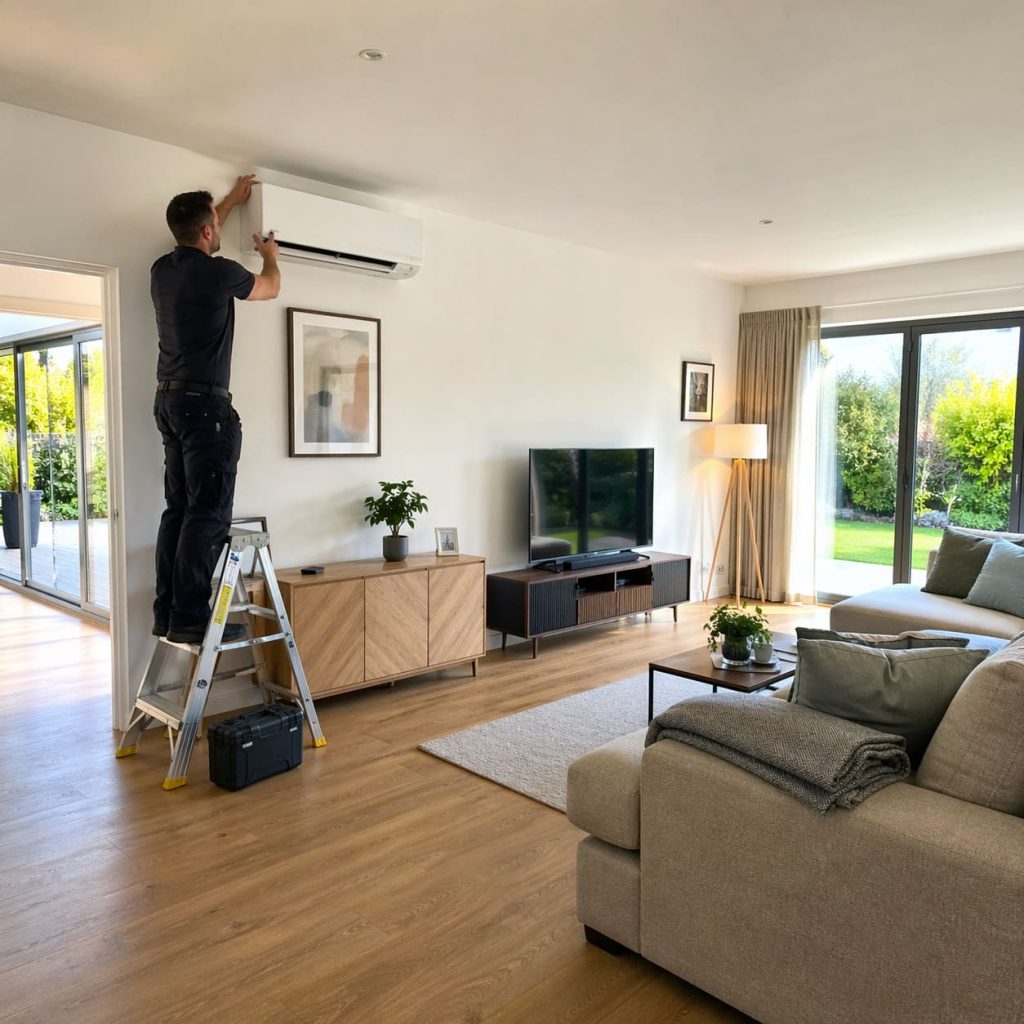
When a system keeps needing regassing, treat it as a leak investigation first, because repeated loss usually points to a fault in the circuit rather than normal wear.

Poor commissioning can damage a good system
A relatively new unit that keeps faulting after installation often points to the pipework and commissioning, not the badge on the front. Bad air conditioning installation leaves evidence in performance, fault history and service records.
Pipework and charge must match the equipment
Manufacturer installation instructions set limits for pipe runs and refrigerant charge because the refrigerant circuit has to work as a balanced system. If pipework is longer than allowed, poorly routed or wrongly calculated, the unit can lose performance even though the indoor and outdoor units are suitable for the room.
Daikin UK installation guidance for one R32 split system states that extra refrigerant is needed beyond a stated pipe length and warns that failing to add the proper amount may reduce performance. That detail matters because refrigerant charge is not a guess. It is part of the installation design.
A poor flare connection, an inaccessible joint or pipework buried where nobody can check it later can turn a repair into a gamble. We want to know whether the fault sits at a visible service point or inside finished fabric that would need opening up again.
Commissioning proves the circuit is ready
Commissioning is the point where the installer proves the refrigerant circuit is clean, tight and ready to run. Vacuum pumping removes air and moisture. A pressure-hold check shows whether the circuit holds steady before the system is opened for use.
Daikin UK’s manual requires vacuum pumping and a pressure-hold check before opening the system. Those checks are basic evidence that the installation was completed properly, and weak commissioning paperwork makes later diagnosis slower.
Early air conditioning compressor damage is hard to judge from symptoms alone. Records help separate a one-off part fault from AC commissioning problems that have been present since day one.

Leaks, noise and tripping point to different faults
Symptoms are clues before diagnosis. A vague label such as “old unit” tells you very little, while the pattern of the fault tells us where to look first.
- Regassing every year: An air conditioner that needs regassing every year needs leak investigation. For stationary air conditioning equipment containing F gas, GOV.UK says leak-check frequency depends on the amount of F gas and its global warming potential, so repeated loss belongs in the service record.
- Water leaking inside: A split air conditioner leaking water inside usually points to condensate drain problems, pump reliability, blockage or a poor hose connection. The drain route matters as much as the indoor unit.
- Noise after installation: A noisy air conditioning unit may be transferring vibration into the structure, struggling for airflow or sitting too close to a sensitive boundary. Outdoor mounting and location decide much of this.
- Tripping out: An air conditioner that keeps tripping out can be reacting to pressure problems, restricted airflow or a control fault. Electrical diagnosis belongs with qualified people, but the fault history still guides the first inspection.
- Blocked airflow: Blocked filters and outdoor heat exchanger dirt can push the system into pressure and performance problems. Manufacturer guidance for a Daikin unit recommends checking the outdoor heat exchanger at least once a year because blockage from dust, dirt or leaves can affect pressure and performance.
A symptom map does not make you the technician. It does help you challenge a thin diagnosis before agreeing to remove equipment that may still have a correctable fault.
Keep commissioning records with service notes and fault codes, since they often show whether the real problem began at installation or later in use.

Repair, redesign or replacement depends on evidence
The useful question is not whether the unit can be made to run again, but whether the same faults will return after the repair. A repair works where the fault is isolated, accessible and backed by a service history that makes sense.
Redesign belongs on the table when the equipment type is broadly suitable but the route through the property is flawed. Poor drainage, awkward controls, weak airflow or a bad outdoor unit position can leave a system constantly close to failure, even after parts are changed.
Replacement becomes the stronger answer when the original problem sits inside inaccessible pipework, finished ceilings or a plant position that the building will never support well. In that case, keeping the old layout only carries the same weakness into the next repair.
Removal also has to be handled as proper air conditioning decommissioning where the refrigerant circuit is involved. GOV.UK says a company working for others on stationary air conditioning equipment containing F gas must be certified to install, repair, maintain and decommission that equipment. A split system is not something to cut out as a general building task.
Current refrigerant rules also affect replacement. In Great Britain, from 2025, new single split systems containing less than 3 kg of refrigerant are subject to an F-gas ban if they contain F gases with a global warming potential above 750, so repeating an old specification may be the wrong route.
Our strongest air conditioning replacement assessment starts with the original failure. Fixing that cause matters more than getting the old unit running for another short spell.

Questions we get asked about early air conditioning removal
What does short cycling tell us about an air conditioning system?
Short cycling means the system is starting and stopping too frequently. We treat it as a clue that sizing, airflow, controls or refrigerant conditions need checking.
Why can a condensate pump become a weak point?
A condensate pump becomes a weak point when the drain route depends on it and access for servicing is poor. If the pump or pipework sits behind finished ceilings, a simple leak can become a repeated property problem.
Can a tidy indoor unit still hide installation problems?
A tidy indoor unit can hide poor pipe routes, weak drainage, bad outdoor siting or missing commissioning records. The visible finish tells us less than the way the whole system was planned and checked.
What records are useful when you inherit an air conditioning system?
Commissioning paperwork, service notes, fault codes, leak checks and details of any refrigerant work all help us understand the system’s history. Without them, we have to rely more heavily on inspection and testing.
Why do fault codes matter if the unit still runs?
Fault codes show patterns that a quick visual inspection can miss. A system that runs today may still be recording pressure, control or sensor issues that explain repeated breakdowns.
