Should you service your air conditioning after summer or wait until spring?
Yes, if your system worked hard, changed performance, also heats the property, or serves a commercial or higher-use space. An end-of-summer service can catch dirt, drainage issues, weak airflow, odours, noise, and refrigerant concerns early. Lightly used domestic units can often wait for a spring check.

Late summer servicing gives the clearest answer when the system has worked hard
Many people treat air conditioning servicing as a spring job. Spring pre-season checks do make sense because they prepare the system before demand rises, but late summer gives you a different kind of information: it shows how the system behaved under real load.
An air conditioning service after summer is most useful when the system has had heavy summer use, cooled several rooms, shown weaker cooling performance, or will switch into all-year heating and cooling. Split air conditioning in a single room may need less attention than multi-split systems, ducted air conditioning, ceiling cassette units, or variable refrigerant volume and variable refrigerant flow systems, usually shortened to VRV and VRF, serving larger spaces.
Use this comparison as a timing guide, since the right answer depends on use and risk rather than the calendar alone.
| Timing | Best fit | What it helps with |
|---|---|---|
| End-of-summer servicing | Heavy use, symptoms, concealed units, multi-room systems, all-year heating and cooling, commercial or higher-duty spaces | Checks what summer has exposed while the evidence is still fresh |
| Spring servicing | Light domestic use, clean filters, no odours, no leaks, no change in sound or cooling | Prepares the system before the next cooling season |
| Waiting for a fault | Low-risk only where comfort is not time-sensitive | Leaves you dependent on repair availability when demand is high |
Seasonal air conditioning check decisions should start with two questions: how hard did the system work, and did anything change? If both answers point to concern, autumn is a sensible time to act. If the unit barely ran and still performs cleanly and quietly, a spring pre-season check can be enough.
Summer use leaves useful clues about system condition
A unit can still run after summer and still be telling you that something has shifted. Slower cooling, weak airflow from an air conditioner, a stale smell, a new vibration, or water near an indoor unit all give a service visit a clear purpose.
Sustained cooling use exposes faults that stay hidden when equipment is idle. Filters collect dust, indoor fan coil units move less air, and a condensate drain can struggle once it has carried moisture through a long spell of operation. Outdoor heat rejection equipment also matters. GOV.UK guidance notes that dirt or debris around outdoor equipment reduces effectiveness, which affects refrigeration efficiency and cooling capacity.
West and North West London properties add another layer. Concealed services, older building layouts, shared walls, and awkward outdoor-unit access can make a small performance issue harder to inspect later. Planned end of summer air conditioning maintenance gives an engineer the chance to check a noisy air conditioning unit, an air conditioning leak after use, or air conditioning that is not cooling properly before the next busy period.
Refrigerant deserves careful handling in this conversation. A system does not simply use up refrigerant as a normal yearly event. Low refrigerant points to a concern in the refrigerant circuit, so a professional check should look for the reason before anyone talks about topping it up.
A service has a diagnostic purpose after summer. Treating every issue as an urgent repair misses the value of reading the signs early.

If a unit smells damp after summer, check whether the condensate drain has been carrying water away properly before assuming the filters are the only issue.

A proper service checks cleanliness and operation
A useful end-of-season air conditioning check-up should cover both what is dirty and how the system is actually running. A quick filter clean has value, but professional air conditioning maintenance looks beyond the visible grille.
Core service checks usually include:
- Filters and airflow. Filters need cleaning or replacement where they are dirty, blocked, damaged, or past the manufacturer’s guidance.
- Coils, fans, and heat exchanger condition. Dust and contamination here affect how well the system transfers heat and moves air.
- Condensate pump or drain. Water needs a clear route away from the indoor unit, especially in concealed or ducted systems.
- Outdoor unit condition. An engineer checks for blocked airflow, debris, and signs that access or location is affecting performance.
- Controls and thermostat. Incorrect settings or poor sensor behaviour can make a working system appear unreliable.
- Electrical connections and running condition. These checks belong with a professional air conditioning engineer.
- Refrigerant check where needed. Regassing should follow investigation, because low refrigerant is a symptom, not a routine consumable.
- Anti-bacterial treatment where relevant. Odours, heavy use, contamination concerns, or indoor air quality requirements can justify deeper cleaning.
Daikin’s manufacturer maintenance guidance says large, commercial-use, and specialty-type equipment needs expert knowledge and should be handled by professionals. That distinction matters in London homes and commercial spaces where the indoor unit may be hidden, the outdoor unit may be hard to reach, and quiet operation matters as much as cooling output.
A London specialist such as RightAir Solutions will usually judge servicing in context, especially where a system is concealed, serving several rooms, or part of a higher-value property where comfort and finish both matter. The better question is whether a unit has been wiped down, but whether the service has checked how it is working after summer.

Owner cleaning supports service visits but does not replace them
Can you do anything useful yourself? Yes, provided you stay with accessible, low-risk tasks and follow the manufacturer maintenance guidance for your model.
What owners can clean
Accessible filters on many split and multi-split systems can be cleaned by the owner. Daikin recommends cleaning filters on those systems once every two weeks, and also states that an obstructed filter reduces intake air and increases the electricity needed to cool the room.
Keeping the area around an outdoor unit clear also helps, provided the unit is easy and safe to access. Basic owner care works best when it stays basic: clean what the manufacturer says you can clean, do not force panels, and do not interfere with electrical parts or sealed equipment.
What an engineer should handle
Ducted systems, concealed indoor units, commercial air conditioning, server room cooling, and larger specialty equipment need a qualified air conditioning engineer. The same applies to refrigerant handling, condensate pump faults, electrical checks, deeper contamination, and persistent odours.
Professional maintenance should be planned and orderly. In a managed property, that means less disruption for occupants and less guesswork for you. Owner cleaning keeps the system in better day-to-day condition, while professional servicing checks the parts you cannot sensibly assess from the front cover.
In multi room or concealed systems, a small change in airflow often tells you more about the need for servicing than the temperature setting does.

Long-term servicing depends on use, duty, and compliance
Air conditioning servicing in the UK is best treated as a long-term care decision, not a fixed seasonal ritual. A lightly used domestic unit, a busy commercial system, and a concealed multi-room installation do not carry the same risk or workload.
Routine servicing is separate from statutory inspection. GOV.UK guidance for England and Wales says air conditioning systems with an effective rated output of more than 12 kW must be inspected by an accredited energy assessor at intervals of no more than five years. Multiple smaller units can also fall within this if their combined cooling capacity under single control is greater than 12 kW. TM44, from the Chartered Institution of Building Services Engineers, is the technical memorandum used for the inspection method under the Energy Performance of Buildings Regulations for England and Wales.
F-gas, meaning fluorinated greenhouse gas, is another separate issue. GOV.UK guidance says stationary air conditioning equipment containing F-gas can need leak checks where the thresholds are met, and the frequency depends on the amount of gas and its global warming potential, expressed as CO2 equivalent. That is a compliance matter, not a reason to present every small domestic unit as legally tied to an autumn service.
For property owners, landlords, estate managers, and facilities managers, the practical framework is simple. Light use with no symptoms can point to spring servicing. Heavy use, odours, leaks, noise, weak cooling, all-year heating and cooling, or commercial duty point to a late summer or autumn check. Higher-duty systems also need their compliance position understood alongside routine servicing.
RightAir Solutions tends to treat planned preventative maintenance as part of the system’s working life, especially where cooling, heating, ventilation, and property constraints overlap. That approach suits London buildings where a late repair visit can mean access problems, occupant disruption, and pressure to fix several issues at once.
Two approaches compete here. One waits until the first hot spell exposes a fault, then relies on a reactive call-out when comfort already matters. The other uses the end of summer to read what the system has just revealed, plan around access and occupancy, and keep performance steady before the next season asks more of it. For most higher-use properties, the second approach works out better long-term.
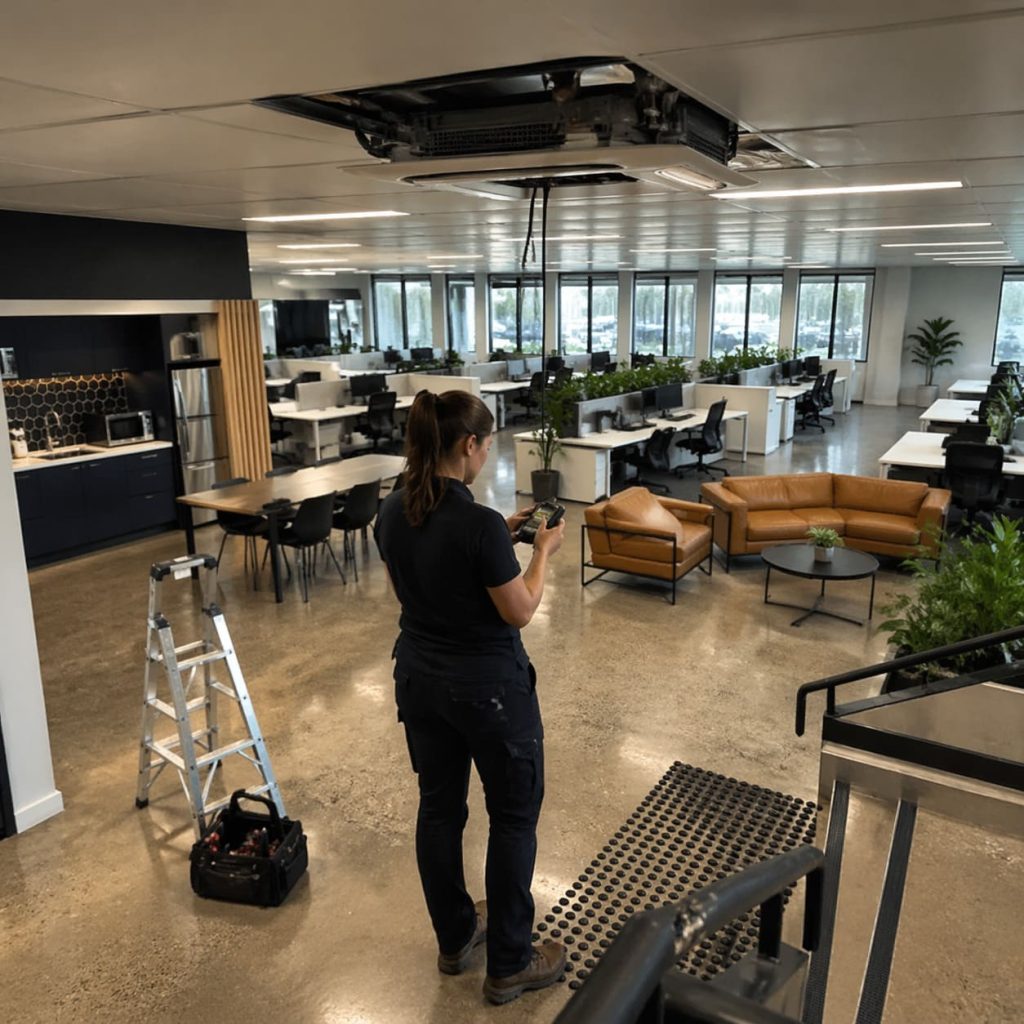
Common questions about air conditioning servicing after summer
Does air conditioning need servicing every year?
Many systems benefit from regular servicing, but every system does not have the same legal or practical need. Use, system type, duty level, symptoms, and any compliance duties decide the right pattern.
Why does air conditioning smell after summer?
A smell after summer can come from moisture, dirty filters, contamination around the indoor unit, or drainage problems. Persistent odours deserve a professional check because cleaning the visible filter may not reach the source.
Should air conditioning be regassed every year?
Air conditioning should not be treated as if it uses up refrigerant each year. If refrigerant is low, the system needs investigation because a leak or fault may be present.
Can a spring service replace an autumn service?
A spring service can be enough where the unit had light use and showed no change in performance. Autumn servicing is more useful where summer exposed weak cooling, noise, odours, leaks, or heavier-than-normal use.
Do commercial air conditioning systems have extra duties?
Some commercial or larger systems have statutory inspection or F-gas leak-check duties in addition to routine servicing. A competent provider will separate those duties from normal maintenance, so the system is looked after properly without treating every task as the same thing.
This is general information, not professional advice.
